

|
|
|
|
|
|


The basic unit of time is the second. There are also minutes, hours, days, weeks, months and years.
We can measure time using clocks.
There are two main ways to show the time: "24 Hour Clock" or "AM/PM":
- the 12 Hours running from Midnight to Noon (the AM hours), and
- the other 12 Hours running from Noon to Midnight (the PM hours).

Converting AM/PM to 24 Hour ClockAdd 12 to any hour after Noon (and subtract 12 for the first hour of the day):For the first hour of the day (12 Midnight to 12:59 AM), subtract 12 HoursExamples: 12 Midnight = 00:00, 12:35 AM = 00:35From 1:00 AM to 12:59 PM, no changeExamples: 11:20 AM = 11:20, 12:30 PM = 12:30From 1:00 PM to 11:59 PM, add 12 HoursExamples: 4:45 PM = 16:45, 11:50 PM = 23:50
Converting 24 Hour Clock to AM/PMFor the first hour of the day (00:00 to 00:59), add 12 Hours, make it "AM"Examples: 00:10 = 12:10 AM, 00:40 = 12:40 AMFrom 01:00 to 11:59, just make it "AM"Examples: 01:15 = 1:15 AM, 11:25 = 11:25 AMFrom 12:00 to 12:59, just make it "PM"Examples: 12:10 = 12:10 PM, 12:55 = 12:55 PMFrom 13:00 to 23:59, subtract 12 Hours, make it "PM"Examples: 14:55 = 2:55 PM, 23:30 = 11:30 PM
TimeAdd or Subtract the hours and minutes separately.But you may need to do some adjusting if the minutes end up 60 or more, or less than zero!
Adding TimesFollow these steps:
- Add the hours
- Add the minutes
- If the minutes are 60 or more, subtract 60 from the minutes and add 1 to hours
- subtract 60 from minutes (65−60 = 5 Minutes)
- and add 1 to Hours (3+1 = 4 Hours)
Follow these steps:
- Subtract the hours
- Subtract the minutes
- If the minutes are negative, add 60 to the minutes and subtract 1 from hours.
Subtract the Hours: 4−1 = 3
Subtract the Minutes: 10−5 = 5
The minutes are OK, so the answer is 3:05
Hard example: What is 4:10 - 1:35 ?
Subtract the Hours: 4−1 = 3
Subtract the Minutes: 10−35 = −25
The minutes are less than 0, so:
- add 60 to Minutes (−25+60 = 60−25 = 35 Minutes)
- and subtract 1 from Hours (3−1 = 2 Hours)
The answer is 2:35

In units of measurement of length we use centimeter (cm) to measure. We can use this unit for measuring the length of a pencil, the width of a book etc. but this unit is too big to measure the thicken of a pencil. So we use another unit called millimeter (mm).
Also, centimeter and millimeters are very small units to measure the length of the classroom. We use another unit called meters. Even meter is too small unit when we state the distances between two cities, there we need kilometers (km).
These units are connected with each other by the following relation :
1 kilometer (km) = 1000 meter (m)
1 meter (m) = 100 centimeter (cm)
1 centimeter (cm) = 10 millimeter (mm).
Also,
1 meter (m) = 100 centimeter (cm) = 100 × 10 millimeter (mm) = 1000 millimeter (mm)
1 kilometer (km) = 1000 meter (m) = 1000 × 100 centimeter (cm) = 100,000 centimeter (cm)
1 kilometer (km) = 100,000 centimeter (cm) = 100,000 × 10 millimeter (mm) = 1,000,000 millimeter (mm)
When we go to market to buy sugar, wheat etc, we buy these items in kilograms (kg).
But, items like ginger, chilies etc. are measured in grams (gm).
In order to measure the weight of compound or chemicals in medicines, we use smaller unit called milligrams (mg).
Following are the relations between these three units of measurement of weight.
1 kilograms (kg) = 1000 grams (gm)
1 grams (gm) = 1000 milligrams (mg)
1 kilograms (kg) = 1000 × 1000 milligrams (mg) = 1,000,000 milligrams (mg)
We buy milk in liters whereas liquid medicines etc. are measured in milliliters (ml).
Following is the relation between these two units.
1 liter (l) = 1000 milliliters (ml).
Following prefixes are used to understand easily the relationship between higher units and lower units.
Kilo – thousand, hector – hundred, deca – ten, deci – tenth, centi – hundredth and milli – thousandth
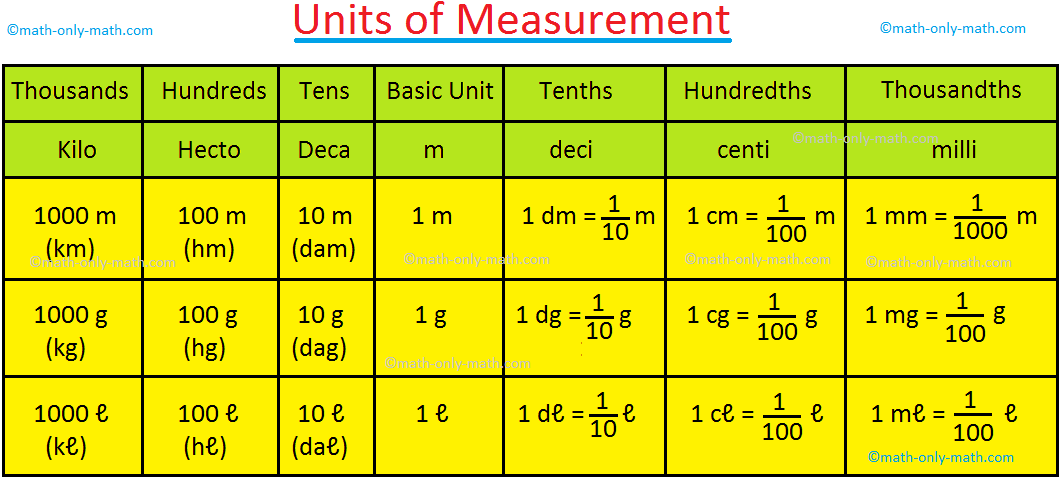
In units of measurement, all the units mentioned above have some common words like kilo, milli and centi. It should be noted that kilo is the largest and milli is the smallest. Similarly, centi shows 100 times smaller.


When we represent numerical data through pictures or graph, it is termed as more clear.
In pictograph we use icon, pictures, symbol etc. repetitively, to show the relationship between two variable quantities. Pictograph can also be referred as pictogram, pictorial chart, pictorial graph, or picture graph. The quantity that each symbol or picture symbolizes is specified clearly in the representation, this helps to represent large quantities of data.

Q1. How many oranges were sold during the third Week?
Ans. 20 x 3 = 60 oranges (as each orange stand for 20 oranges)
Q2. In which Week the oranges sold were maximum?
Ans. In Week 2


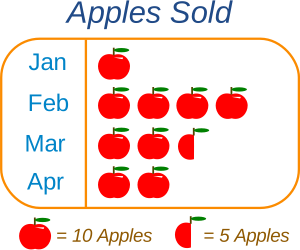
So the pictograph is showing:
- In January 10 apples were sold
- In February 40 apples were sold
- In March 25 apples were sold
- In April 20 apples were sold
| Library Visit | |
| Month | Number of children |
| January | 40 |
| February | 35 |
| March | 50 |
To represent this data on a pictograph, follow the given steps:
- Think of a picture or a symbol to represent the children.
- Then, decide on a suitable scale to represent the number of children. For a scale of 10, each symbol or picture would represent 10 children.


Do Exercise-20A ,Nos 6-10 page nos179-180 in text-book.


Page nos:-171-174
Perimeter of Rectangle
= L + L + B + B
OR
=2 X L + 2 X B (i.e. 2L + 2B)
OR
=2 (L + B) (taking 2 common i.e. twice the sum of length and breadth)

Method 1: Perimeter = 10 + 10 + 5 + 5 (sum of all 4 sides)
= 30 cm
Method 2: As opposite sides are equal we can write sum 2 times length and 2 times breadth.
Perimeter = 2 X L + 2 X B (i.e. 2L + 2B)
= 2 x 10 + 2 x 5
= 20 + 10
= 30 cm
OR
Perimeter = 2 (L + B)
= 2 (10 + 5) (solve bracket first)
= 2 X 15
= 30 cm
Video-1 Perimeter
Page nos:- 169-170


Ch-13 Measure of Time
Page nos:- 148-153


Step1: Write the units on the top.
Step2: Write the numbers in proper place below the units. Write zero in empty place.
Step3: Now add or subtract as per the instruction given in question.
Example 1: Add 3 hrs 35 min 50 sec and 2 hrs 40 min 34 sec

= 6hrs 16min 24sec

We have 80 sec and we can subtract 30 sec from 80 sec.
80 sec – 30 sec = 50 sec
We have 94 min and we can subtract 45 min from 94 min.
94 min – 45 min = 49 min

1 hour = 60 minutes
1 minute = 60 seconds
1 hour = 60 x 60 = 3600 seconds
1 day = 24 hours
Therefore, 2 hrs = 2 x 60 = 120 min
2 hrs 40 min = 120 min + 40 min = 160 minutes
60 min = 1 hour
Therefore, 180 min = 180 ÷ 60 = 3 hours

1 min = 60 sec
Therefore, 5 min = 5 x 60 = 300 sec
5 min 37 sec = 300 sec + 37 sec = 337 seconds
60 seconds = 1 minute
Therefore, 240 seconds = 240 ÷ 60 = 4 minutes

1 day = 24 hours
Therefore, 5 days = 5 x 24 = 120 hours
5 days 10 hrs = 120 + 10 = 130 hours
24 hours = 1 day
Therefore, 145 hrs = 145 ÷ 24 hours


In this case use a.m. if number of hours is less than 12 and if numbers of hours is more than 12 then subtract 12 from the number of hours given and use p.m.
Example 1: 0400 hrs.
Here, number of hours is less than 12. So, time according to 12 hours clock time is 4:00 a.m.
Example 2: 1640 hrs.
Here, number of hours is more than 12. So, we will subtract 12 from 16 hours and add p.m.
Time according to 12 hours clock time is (16 – 12 = 4) hrs. = 4:40 p.m.

Here time is before 1 p.m. So, we will simply write the time in 24 hours clock time format i.e. 0525 hrs.
Example 2: 6:10 p.m.
Here time is beyond 1 p.m. So, we will add 12 to the hour part of the given time.
(6 + 12 = 18) hrs.
1810 hrs.
Chapter-13 Measure of Time
( Download Ch-13 in pdf by clicking on the chapter's name above.)


|
Fun
Facts
|

1 Hectogram (hg) = 100 times gram
1 Kilogram (kg) = 1000 times gram
1 Decigram (dg) = 1/10 of gram
1 centigram (cg) = 1/100 of gram
1 milligram (mg) = 1/1000 of gram
Therefore, 9 x 1000g = 9000g
Example 2: Change 5g into centigrams
1g = 100cg
Therefore, 5 x 100cg = 500cg
Step2: Write the numbers in proper place below the units. Write zero in empty place.
Example 1: Add 41kg 36g and 24kg 3g


1 Hectoliter (hl) = 100 times liter
1 Kiloliter (kl) = 1000 times liter
1 Deciliter (dl) = 1/10 of liter
1 centiliter (cl) = 1/100 of liter
1 milliliter (ml) = 1/1000 of liter
Therefore, 6 x 1000l = 6000l
Example 2: Change 45l into centiliters
1l = 100cl
Therefore, 45 x 100cl = 4500cl
Example 1: Change 8000l to kilo liter
1000l = 1kl
Therefore, 8000 ÷ 1000 = 8l


( Download Ch-12 in pdf by clicking on the chapter's name above.)
Page nos:-124-127
In measurement chart we will learn about different types of conversions, we are going to learn math conversion of length, mass and capacity and after going through this units, the learner will be able to learn the measurement of length, measurement of mass and measurement of capacity from one unit to another, both from a smaller unit to a larger unit and vice-versa.
Metric Measure of Length
Measurement of something from its one end to the other is called its length. The standard unit of length is meter. We use different units to measure different lengths. Millimeter, centimeter , decimeter are smaller unit used to measure smaller distance, meter is used to measure average distance, whereas units like decameter, hectometer and kilometer are used to measure longer distance. All these units are related to each other.
Changing Metric Units of Length

When we move from one metric unit to another to the right in the above metric chart, the value of metric unit becomes ten times smaller i.e. one tenth and when we move from one metric unit to another to the left in the metric chart, the value of metric unit becomes ten times bigger.
Conversion of measures from higher to lower units
We always multiply when we change higher unit to lower unit.
Example 1: Change 4km into meters
1km =1000m
Therefore, 4 x 1000m = 4000m
Conversion of measures from lower to higher units
We always divide when we change lower unit to higher unit.
Example 1: Change 6000m to kilometer
1000m = 1km
Therefore, 6000 ÷ 1000 = 6km
Addition and Subtraction
Step1: Write the units on the top.
Step2: Write the numbers in proper place below the units. Write zero in empty place.
Example 1: Add 45km 34m and 34km 5m

Example 2: Subtract 15km 30m from 35km 45m

( Download Ch-11 in pdf by clicking on the chapter's name above.)
Page nos:-121-122
In unitary method we will learn how to find the value of a unit from the value of a multiple and the value of a multiple from the value of a unit.
When we go to the market to buy any article, we ask the shopkeeper to tell the price of the article. This is called unit price. We calculate the price of number of articles, we want to buy, with the help of this unit price. Sometimes, we calculate unit price when the price of a multiple is given. The method to calculate the price of the required articles is called unitary method.
Generally, first we find the value of one article from the value of a multiple and then we find the value of the desired number of articles from the value of one. Usually this method involves the operations of multiplication and division both.
For example,
(i) A pack of 6 balls costs $ 48 and we have to buy 4 balls.
(ii) 20 oranges cost $ 60 and we have to buy 8 oranges.
(iii) The cost of 100 kg of wheat is $ 850 and we have to buy 40 kg of wheat.
In all such cases, first we find the unit cost for calculating the cost of the desired number of articles. To find the unit cost we divide the cost of many articles by the number of articles.
Let us consider some examples on unitary method:
1. 2 balls cost $ 8. Find the cost of 3 balls.
Cost of 2 balls = $ 8
Cost of 1 ball = $ 8 ÷ 2 = $ 4
Cost of 3 balls = $ 4 × 3 = $ 12
2. Cost of 1 book is $ 20. What is the cost of 10 such books?
Cost of 1 book = $ 20
Cost of 10 books = $ 20 × 10
= $ 200
3. 12 oranges cost $ 72. Find the cost of 4 oranges.
Cost of 12 oranges = $ 72
Cost of 1 orange = $ 72 ÷ 12 = $ 6
15 / 09 / 2021


Chapter-10 Money
Page nos:-116-119
× 4
Rs. 37.00


- Rs 32.84
Rs 40.14
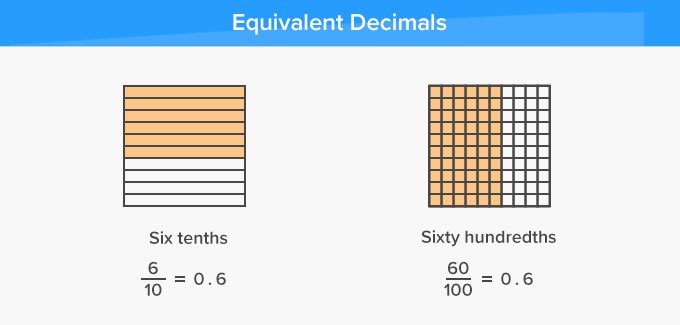
7.5, 23.16, 31.054, etc. are unlike decimals. As in 7.5 has one decimal place. 23.16 has two decimal places. 31.054 has three decimal places
A. First compare the whole number part of the decimal number. Decimal with the greater whole number is greater.
1. Compare 23.14 and 8.67
Solution:
In 23.14 the whole number part is 23 and in 8.67 the whole number part is 8.
But 23 > 8
Therefore, 23.14 > 8.67
In 53.47, the decimal part is .47 and the digit in the tenths place is 4.
In 53.81, the decimal part is .81 and the digit in the tenths place is 8.
But 8 > 4
Therefore, 53.81 > 53.47
In 81.39 and 81.37, the decimal part in the tenths place is the same, i.e., 3
In 81.39, the decimal part is .39 and the digit in the hundredths place is 9.
In 81.37, the decimal part is .37 and the digit in the hundredths place is 7.
But 9 > 7
Therefore, 81.39 > 81.37


Like Fraction Definition: Fractions that have the same denominators are like fractions. For example, the fractions 2/7, 3/7, 5/7, and 6/7 all have the same denominator – 7. Hence, these are like fractions.


Fraction of a whole: When we divide a whole into equal parts, each part is a fraction of the whole.
For example,
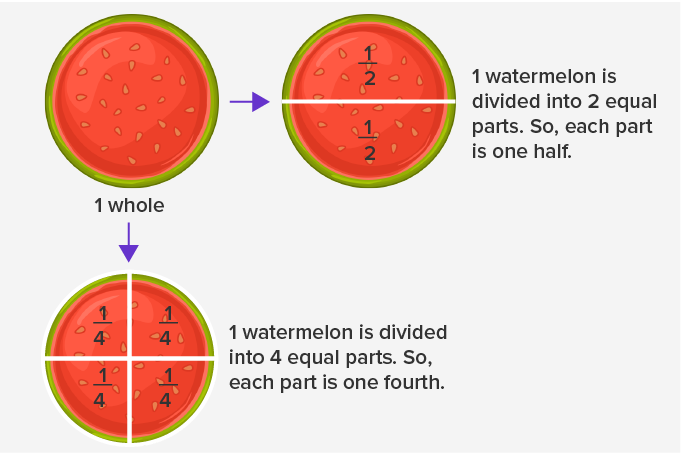
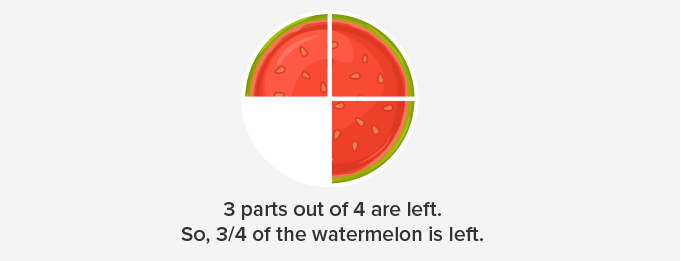
For example,
There are total of 5 children.
3 out of 5 are girls. So, the fraction of girls is three-fifths ( 3⁄5 ).
2 out of 5 are boys. So, the fraction of boys is two-fifths ( 2⁄5 ).
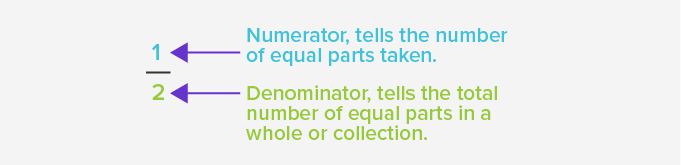
A fraction has two parts. The number on the top of the line is called the numerator. It tells how many equal parts of the whole or collection are taken. The number below the line is called the denominator. It shows the total divisible number of equal parts the whole into or the total number of equal parts which are there in a collection.
Fractions on a number line: Fractions can be represented on a number line, as shown below.
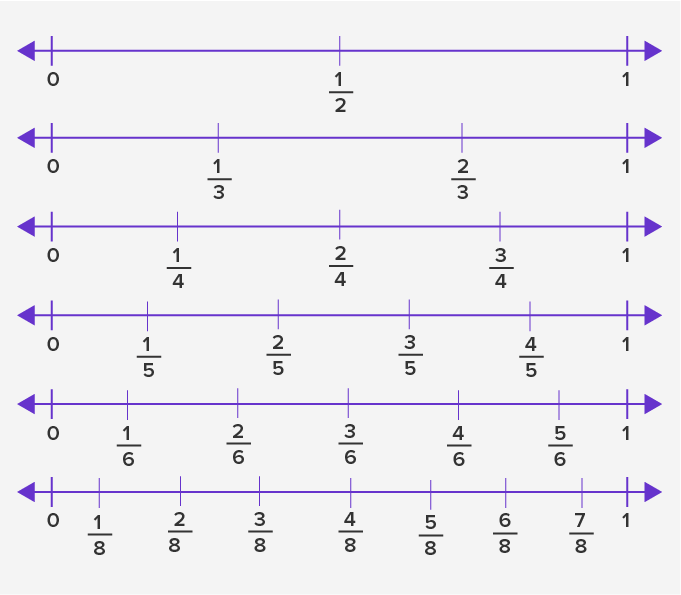
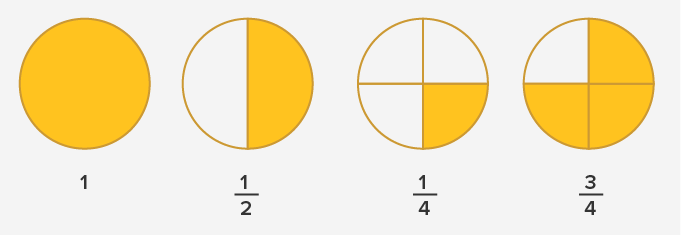
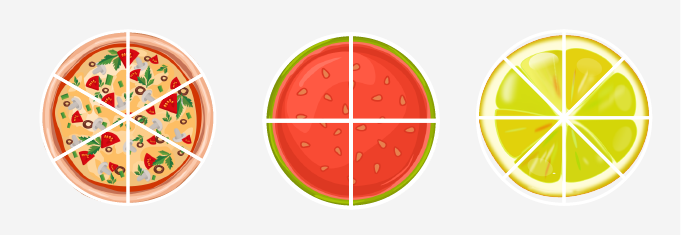
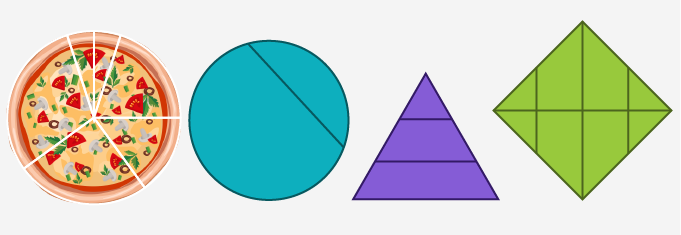
The most common examples of fractions from real life are equal slices of pizza, fruit, cake, a bar of chocolate, etc.


Prime factors of 35 = 5, 7
Common factor of 15 and 35 = 5


(Download Ch-7 in pdf by clicking on the chapter's name above.)


Since 95 bags contain wheat 9975 kg



Page no:- 31


Chapter- 3 Subtraction
(Download Ch- 3 in pdf by clicking on the chapter's name above)
Page nos:- 19-24


Page nos:- 16-17


Page nos:- 12-14


Do Exercise- 2A Nos 1-24 in your text book and Nos 25-33 in your ex-bk page nos- 15-16.
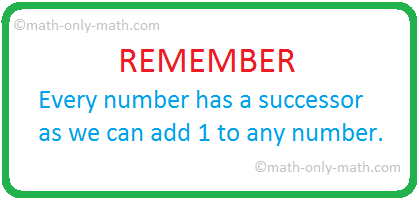


Video-1 Successor and Predecessor
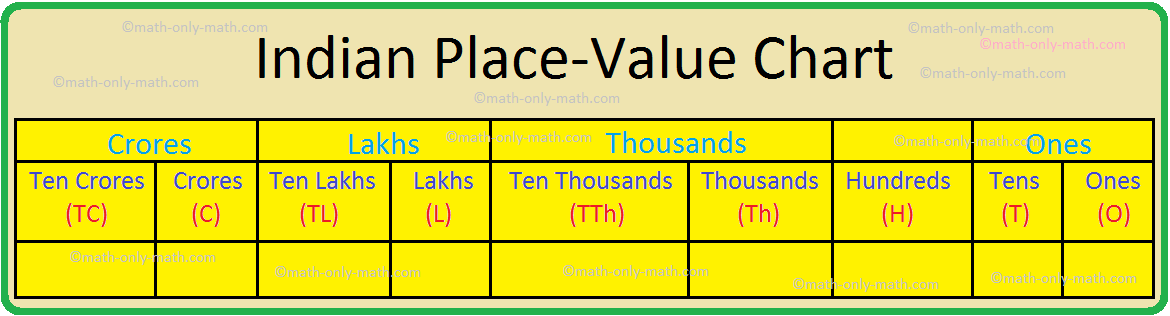

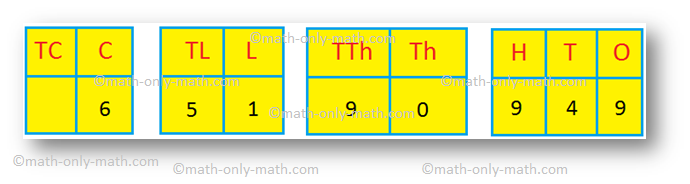
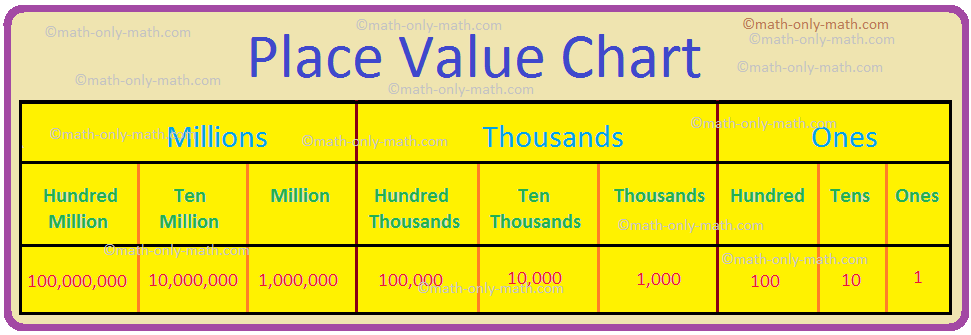
Video-1 Indian and International Place Value System
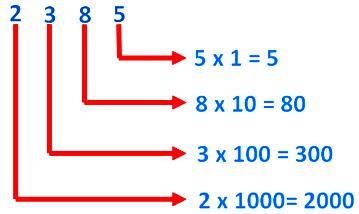
Video-2 Expanded Form
Page nos :- 2 and 3
Numbers showing on an abacus helps the students to understand the number and its place value. Abacus is very helpful to understand the concept of magnitude and name of a number. We know that the spike-abacus represents the number of multi-digits where the digits are represented by the spikes of the abacus.
The spikes from right to left represent the places of the place values of the digits in increasing order i.e., 1, 10, 100, ………. etc.
These places are denoted by O (unit or ones), T (tens), H (hundreds), Th (thousands), T th (ten thousands), H th (hundred thousands) and so on ……… .

(Download Ch- 1 in pdf by clicking on the chapter's name above.)
Page nos :- 1 and 2
INTRODUCTION
‘Numbers rule the Universe’. They play an important role in Mathematics. Numbers can be expressed in figures as well as words.
Numeral of a Number : The group of figures representing a number is called the numeral of that number.
We know that, the
Greatest 3digit number → 999 + 1 = 1000 ← Smallest 4- Digit Number.
Greatest 4digit number → 9999 + 1 = 10000 ← Smallest 5- Digit Number.
We read 10000 as "Ten Thousand".
In the place value chart the fifth place from the right is called the "Ten Thousands Place".
TTH | TH | H | T | O |
1 | 0 | 0 | 0 | 0 |
Each number beyond 10000 can be obtained by adding 1 to the number.
Let's have a look at some of the 5 -digit numbers.
NUMERAL | HOW WE READ |
10000+1=10001 | TEN THOUSAND ONE |
10001+1=10002 | TEN THOUSAND TWO |
10002+1=10003 | TEN THOUSAND THREE |
10999+1=11000 | ELEVEN THOUSAND |
20000+1=20001 | TWENTY THOUSAND ONE |
20001+1=20002 | TWENTY THOUSAND TWO |
99998+1=99999 | NINETY NINE THOUSAND NINE |
99999 is the largest 5 Digit Number.
Now, 99999 + 1 = 100000 is the smallest 6- Digit Number.
We read 100000 as "One lakh".
In the place value chart, the sixth place from the right is called the lakh's place.
L | TTH | TH | H | T | O |
1 | 0 | 0 | 0 | 0 | 0 |
In the place value chart, the sixth place from the right is called the lakh's place.
We add 1 to 100000 to get 100001. Further, we add 1 to 100001 to get the next number i.e., 100002. Continuing in this manner, we get 999999 as the largest 6 digit number.
We read 999999 as nine lakh ninety nine thousand nine hundred and ninety nine.
Again 999999 + 1 = 1000000 ,this is the smallest 7- digit number.
We read 1000000 as Ten Lakh.
In the place value chart, the seventh place from the right is called the ten lakh's place.
TL | L | TTH | TH | H | T | O |
1 | 0 | 0 | 0 | 0 | 0 | 0 |
Let's have a look at the following place value chart.
TL | L | TTH | TH | H | T | O |
TEN LAKHS | LAKHS | TEN THOUSAND | THOUSAND | HUNDRED | TENS | ONES |
The value of a place to the left of any digit in a number is 10 times, two places to the left is 100 times, three places to the left is 1000 times and so on.
Video-1 Large Numbers
Study and practice Ch-1 page nos 1-2.


